Something changed in how the world uses AI, and 2026 is the year it became obvious. AI stopped being a novelty you ask questions to and became a set of tools that do real work for you. This guide explains that shift in plain terms, shows how to learn AI without coding, and points you to the simplest place to start if you run a business or are starting from scratch.
- The 2026 shift is from asking AI questions to building AI that does the work, often called AI agents or agentic AI.
- You do not need to code. Most business use of AI today is no code and runs on plain language.
- The fastest way to learn is to solve one real problem with AI, not to study everything at once.
- A free live training such as the AI Business Summit is a low risk first step for beginners and business owners.
What is the AI shift happening in 2026?
The AI shift of 2026 is the move from using AI as a chatbot to using AI as a workforce. For a few years, most people used AI to answer questions, draft a paragraph or summarize a document. That was useful, but it was still you doing the work with a helper. Now the tools can take a goal and carry out the steps themselves, which is why so many searches and headlines focus on AI agents and agentic AI.
For business owners and professionals, the practical version of this shift looks simple. Work that used to eat your week can now be handled by systems you set up once. Here is the change in plain terms:
| The old way (asking AI) | The 2026 way (AI doing the work) |
|---|---|
| Ask a chatbot to draft one email | An agent writes and sends your follow ups on a schedule |
| Copy and paste between tools | Automations move the work between tools for you |
| Research a topic yourself | An agent gathers, sorts and reports back the findings |
| Do repetitive tasks by hand | A simple workflow handles the busywork on autopilot |

This is why the moment matters. The people learning this early are not becoming programmers. They are learning to point current tools at real tasks, which is a skill almost anyone can build.
Why is this shift happening now?
Three things lined up at the same time. First, the models got good enough to follow multi step instructions reliably, so a tool can plan and act instead of only replying. Second, a wave of no code builders arrived, so connecting AI to your email, your documents and your other apps no longer needs an engineer. Third, the tools learned to use a computer the way a person does, clicking, typing and browsing, which means they can finish tasks inside the software you already use.
Put together, that turns AI from a clever answer machine into something closer to a capable assistant you can delegate to. The barrier is no longer technical skill. It is knowing what to hand off and how to set it up, and that is a learnable habit, not a degree.
See the shift in action, for free
The AI Business Summit is a free live event where Alicia Lyttle walks beginners and business owners through turning AI into real results, with no coding required.
Save My Free Seat Free live event · Attend from anywhereWhy is now the right time to learn AI?
Now is the right time because the tools are finally simple enough for non technical people, and the gap between those who use AI and those who do not is widening fast. You do not need to be an early adopter or a data scientist. You need a clear starting point and one workflow that pays off, then a second, then a third.
There is also a real skills gap opening up. Businesses want people who can apply AI to marketing, operations, content and customer service, and they are not finding enough of them. That demand rewards practical ability far more than theory, which is good news if you learn by doing rather than by reading papers.
You can see it play out by role. A marketer who uses AI ships campaigns in hours instead of days. A small business owner answers customers around the clock without hiring. A freelancer takes on more clients because the busywork runs itself. None of them started as technical experts. They started with one task and kept going.
Do you need to code to learn AI?
No, you do not need to code to learn AI in 2026. The most valuable business skill right now is knowing what to ask an AI tool and how to connect a few tools into a workflow, all through plain language and visual builders. This is often described as no code, and it is where most of the results are happening.

If the fear of programming has kept you on the sidelines, that barrier is mostly gone. Learning AI for business today is closer to learning a smart set of apps than learning software engineering. That is exactly why courses built for non techies and for beginners convert curiosity into real use so quickly.
In practice you will work with a few kinds of no code tools: chat assistants that write and think with you, automation builders that connect your apps and run tasks on a trigger, and agent builders that let you set up a tool to complete a job on its own. You do not need all of them on day one. One assistant and one automation is enough to feel the difference in your week.
What can you actually do with AI in your business?
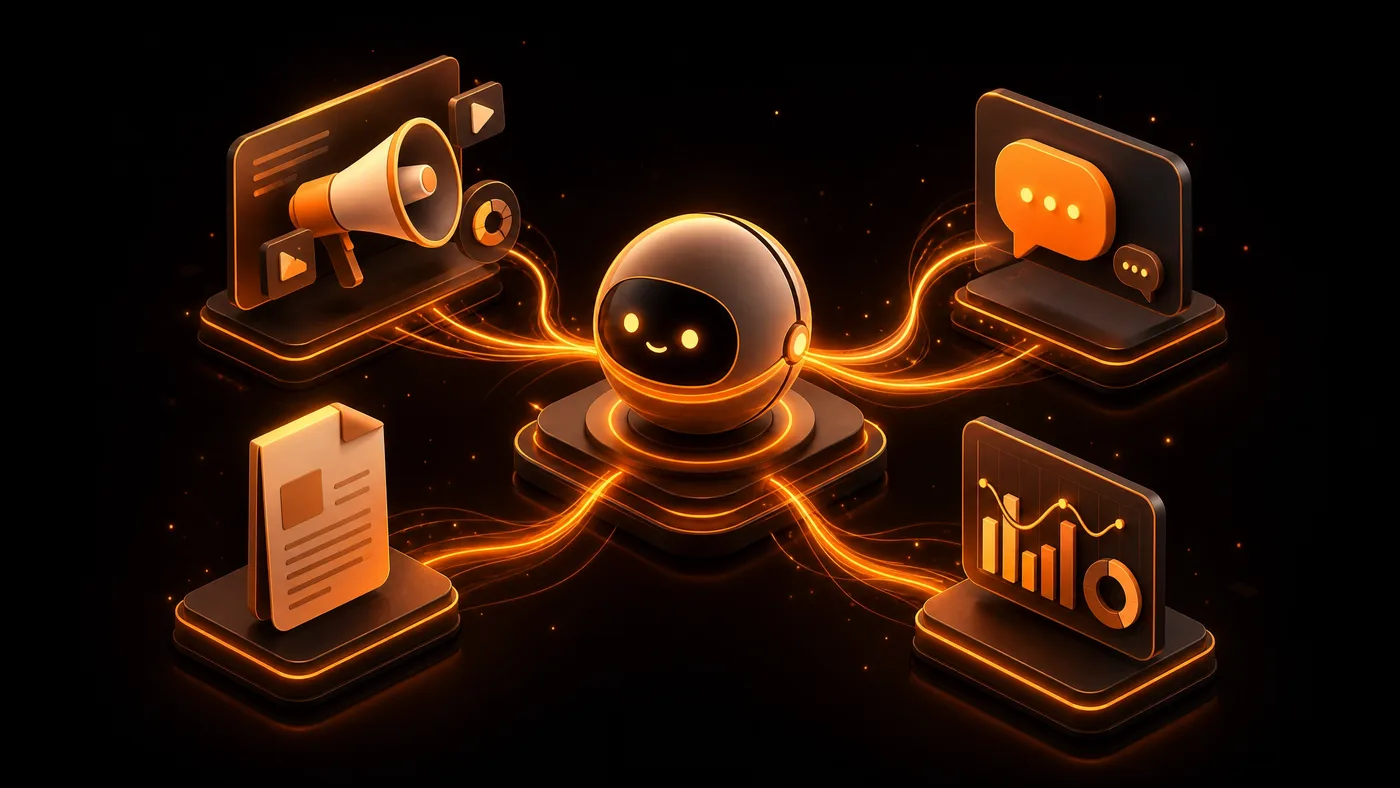
Plenty, and you can start this week. The point of learning AI is not the tools themselves, it is the hours and the output they give back. Here are the most common ways beginners and business owners put AI to work:
- Marketing and content. Draft posts, emails and ad copy, turn one piece of content into ten, and plan a month of content in an afternoon. This is why how to use AI in digital marketing is one of the most searched skills right now.
- Customer service. Answer common questions day and night, summarize long threads, and draft replies that still sound like you.
- Operations and admin. Turn messy notes into clean documents, organize files and tasks, and automate the small steps that quietly eat your day.
- Research and decisions. Gather and compare information, summarize long reports, and lay out the options so you can decide faster.
- Sales and follow up. Personalize outreach at scale and make sure no lead goes cold because a follow up was late.
Notice the pattern. None of these need code. They need someone who knows which task to point AI at, which is exactly the skill this shift rewards.
What should a beginner learn first in AI?
Start small and in order. Trying to learn everything at once is the most common reason people stall. Here is a simple roadmap that works for beginners and business owners:
- The fundamentals. Spend a little time understanding what AI tools can and cannot do, in plain terms. You are not memorizing theory, you are learning to spot good use cases and skip the ones that waste time.
- Prompting. Learn to write clear instructions, give context, and ask for the format you want back. This one skill quietly improves every result from every tool.
- One workflow. Pick a single task you repeat every week and set up AI to handle it end to end. A small, real win builds more momentum than a dozen tutorials.
- AI agents. Once one workflow runs smoothly, move up to agents that carry out multi step tasks for you and check their own work along the way.
- Apply it to your goal. Point the skill at your job, your marketing, or a service you can offer others. This is where learning turns into income or hours saved.

How long does this take? Most people feel genuinely useful within a few weeks of steady practice, not months. The trick is to keep each step small enough to finish. Momentum, not marathon study sessions, is what carries you through.
Definition: An AI agent is a tool you set up to carry out a task from start to finish, not just answer a single question. You give it a goal, and it takes the steps. A group of agents working together is often called agentic AI, and it is the core of the 2026 shift.
Do you need math or an engineering background?
No, not for the applied path, and the applied path is what most people actually want. It helps to separate two goals that often get blended together.
Building AI models from the ground up, the work behind terms like AI engineering and machine learning, does lean on math, data and code. That is a specialized career, and a fine one to chase if it excites you. Using AI to get real work done is a different skill entirely. It is about judgment, clear instructions and knowing which tool fits the job, none of which requires calculus.
For a business owner, marketer, coach or freelancer, the applied path is the one that pays off fastest. You can always go deeper later. Starting does not mean picking a lane for life, it just means starting.
Where should you start?
The lowest risk starting point is a free live training that shows you the tools in action and hands you a plan to follow. That removes the two things that stop most beginners: not knowing where to begin, and not having a next step after the excitement fades.
This is where the AI Business Summit fits. It is a free live online event hosted by Alicia Lyttle, an AI strategist and TEDx speaker known for making AI simple for non technical people. The focus is practical: turning AI into income and efficiency with an AI content system, an AI assistant, and a simple launch plan. Getting started is simple, and like anything worth building, it rewards the work you put in.
A good first session does three things. It shows you the current tools in action so the ideas feel concrete, it gives you a simple plan so you know your next step, and it puts you around other people starting the same way so momentum is easier to keep. That is a calm way to replace guesswork with a path, without spending anything to find out if AI is for you.
Start with the free AI Business Summit
A practical, beginner friendly way to see the 2026 AI shift up close and leave with a plan, not just ideas.
Register Free AI Business Summit · Live · Replays includedFrequently asked questions
Is AI easy to learn in 2026?
Yes, learning to use AI is easier than most people expect. Modern tools are built around plain language, so you type what you want in normal words. The skill that matters now is knowing what to ask and how to put AI to work, not coding or math.
Can I learn AI without coding?
Yes. Most business use of AI in 2026 is no code. You use visual tools and plain language prompts to write, research, organize and automate work. You do not need to program to get real results.
Can I learn AI by myself?
You can, and many people do. Structure helps you move faster, which is why free live trainings and guided courses are popular. They save you from months of trial and error by giving you a clear path.
Do I need math to learn AI?
Not for using AI. Math matters if you want to build AI models from scratch, which is a specialized engineering path. To apply AI to your work or business, you need clear thinking and good instructions, not advanced math.
How long does it take to learn AI?
Most people become genuinely useful within a few weeks of steady, hands on practice. You do not need to master everything. Learning one workflow at a time and applying it right away is faster than trying to study it all up front.
How do I start a career or business with AI?
Pick one real problem you or a business faces, learn the tools that solve it, and build a small working system. A free live training such as the AI Business Summit is a low risk way to see the tools and get a plan to follow.
Is a paid AI course worth it in 2026?
A good paid course is worth it when it gives you structure, live guidance and a clear path to results, which saves months of trial and error. Many people start with a free live training first, then decide if a paid program fits their goals.

About: AI Summit Lab covers practical AI training and events for beginners and business owners, including the AI Business Summit 2026 hosted by AI strategist and TEDx speaker Alicia Lyttle. Our focus is real world use of AI, minus the hype.